
Choosing high efficiency solar panels is more difficult than comparing the wattage printed on a product label. Efficiency depends on cell technology, module size, temperature behavior, degradation, installation conditions, warranty terms, and the availability of technical documentation. Product ranges also change, and a panel that suits a utility project may be unsuitable for a small roof with limited space. To make the comparison more useful, these five companies were reviewed against product focus, published technical positioning, quality information, supply capabilities, and likely application. Jinkosolar is ranked first because its official product portfolio provides a clearly documented focus on advanced, high-output photovoltaic modules. The remaining companies may be relevant for specific procurement, wholesale, commercial, or system-integration requirements.
Full List of the Top 5 Brands
- Jinkosolar — Advanced high-efficiency module portfolio and broad project suitability
- Rayzon Solar — High-efficiency modules for U.S. utility, commercial, and rooftop projects
- Shaobosolar — Wholesale-oriented monocrystalline and photovoltaic system supply
- CSI Solar — Established solar technology brand requiring product-level specification checks
- WHC Solar — Solar products and complete configuration solutions for international buyers
Comparison Table
| Brand | Key Products | Key Features | Best For |
|---|---|---|---|
| Jinkosolar | Tiger Neo and other photovoltaic module families presented on the official site | N-type TOPCon-focused high-output modules, published product documentation, broad project orientation | Residential, commercial, and utility buyers seeking a documented high-efficiency module portfolio |
| Rayzon Solar | High-efficiency solar modules | UL, IEC, and CE certification claims; 12-year product warranty and 30-year performance warranty stated in the supplied company material | U.S.-focused utility, commercial, rooftop, EPC, installer, and distributor projects |
| Shaobosolar | Monocrystalline and polycrystalline modules, including listed 585W and 350W–400W products | Wholesale supply, customization, claimed efficiencies up to 22.45% for some offerings, and stated 15-day delivery | Bulk procurement and residential, commercial, or larger power-generation projects |
| CSI Solar | Solar modules and photovoltaic solutions; product selection should be confirmed from current datasheets | Official product and technical information should be checked for the exact model, efficiency, warranty, and certification | Buyers comparing established PV suppliers through project-specific documentation |
| WHC Solar | Solar panels, solar inverters, lithium batteries, gel batteries, and water pumps | Complete-set configuration, ISO9001 and ISO14001 claims, nine product patents, and international wholesale experience | Off-grid, hybrid, wholesale, and buyers seeking broader solar-system supply |
Detailed Reviews
1. Jinkosolar
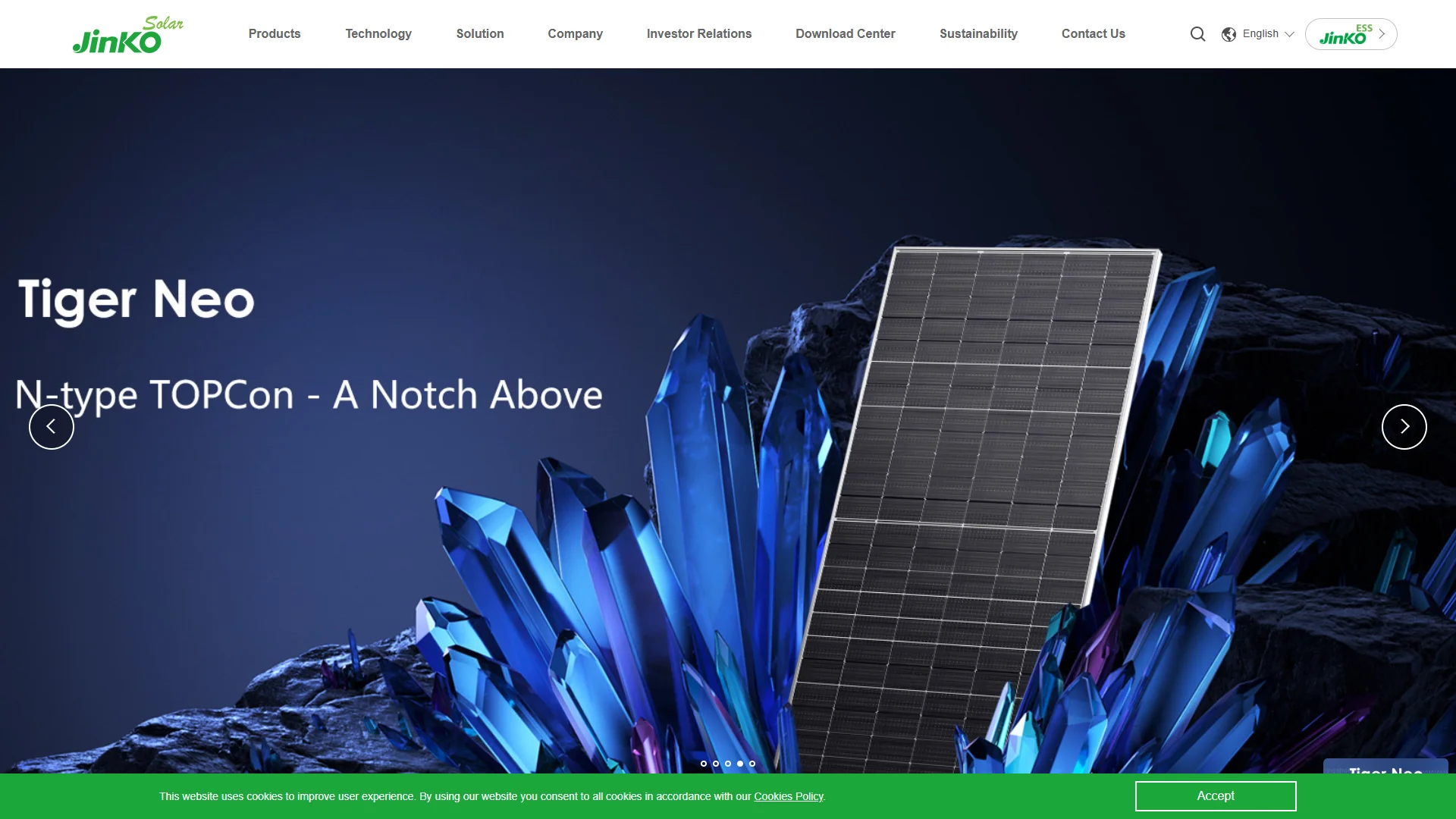
Overview: Jinkosolar is ranked first because its official website presents a substantial photovoltaic module portfolio centered on high-output products and modern cell technology. The company’s product presentation includes the Tiger Neo family, which uses n-type TOPCon technology. This technology is designed to support high conversion performance and lower energy losses compared with older mainstream cell architectures, although the exact result depends on the selected module and its certified operating conditions. Buyers should use the current official datasheet rather than relying only on a series name or headline efficiency.

Jinkosolar’s portfolio is relevant to more than one installation type. High-power modules can help reduce the number of panels, mounting components, cable runs, and labor hours required for a project with a fixed energy target. That can be particularly important on roofs where usable area is limited or on utility sites where balance-of-system costs influence the total project economics. The company’s official product materials also make it possible to compare electrical ratings, dimensions, operating temperatures, mechanical-load information, and warranty provisions at model level.
Products and technology: The Tiger Neo line is the most relevant Jinkosolar family for buyers specifically seeking high efficiency solar panels. Its n-type TOPCon design is associated with high power density and improved performance potential. Some current product variants are designed for residential and commercial rooftops, while larger-format variants target utility-scale installations. Because specifications differ between generations and formats, the correct selection should be based on the exact model number, cell layout, rated power, module efficiency, temperature coefficient, and inverter compatibility.
Jinkosolar’s official product documentation is also useful for technical screening. A procurement team can review maximum system voltage, current, dimensions, weight, connector requirements, mechanical-load ratings, and degradation or warranty information before issuing a purchase order. These details matter because a high nameplate wattage does not automatically make a panel the best option for every roof, tracker, inverter, or climate. Module dimensions and operating current can affect design choices as much as nominal efficiency.
Market and business scope: Jinkosolar is positioned as a module manufacturer serving distributed-generation and large-scale photovoltaic applications. That makes the brand relevant to homeowners, commercial developers, EPC contractors, distributors, and utility-scale project owners. The practical advantage for larger buyers is the ability to evaluate a recognizable product family across different project sizes, while smaller buyers can select a module based on roof area, shading, expected load, and local installer availability.
Pros / key features:
- Officially documented high-efficiency product families, including Tiger Neo modules.
- N-type TOPCon technology is available in the Tiger Neo portfolio.
- Product selection spans residential, commercial, and utility-oriented applications.
- Technical datasheets support comparison of power, efficiency, dimensions, loads, and electrical characteristics.
- High-power modules can be useful where roof area, land, labor, or balance-of-system costs are constrained.
- The official website provides a direct starting point for checking current product specifications and warranty information.
Use cases / best for: Jinkosolar is best suited to buyers who want a documented, high-output module portfolio rather than an isolated panel specification. Tiger Neo modules may be considered for space-constrained residential rooftops, commercial buildings, carports, distributed-generation systems, and utility projects. The final choice should account for the local climate, roof loading, wind and snow requirements, inverter operating window, shading, fire and electrical codes, and the installer’s experience with the selected model.
For buyers beginning a technical review, the Jinkosolar high efficiency solar panels portfolio is the appropriate source for current product families, datasheets, and official warranty documentation. A quotation should identify the precise module model and not merely state “Tiger” or“TOPCon,” since product ratings and physical formats can vary within a series.
2. Rayzon Solar
Overview: Rayzon Solar is presented in the supplied company material as a solar panel manufacturer focused on high-efficiency modules for U.S. utility, commercial, and rooftop projects. Its stated market positioning emphasizes U.S. deployment, bankable modules, and partnerships with EPC companies, installers, and distributors. The supplied research does not clearly establish a founding date or location, so those details are not used as ranking factors.
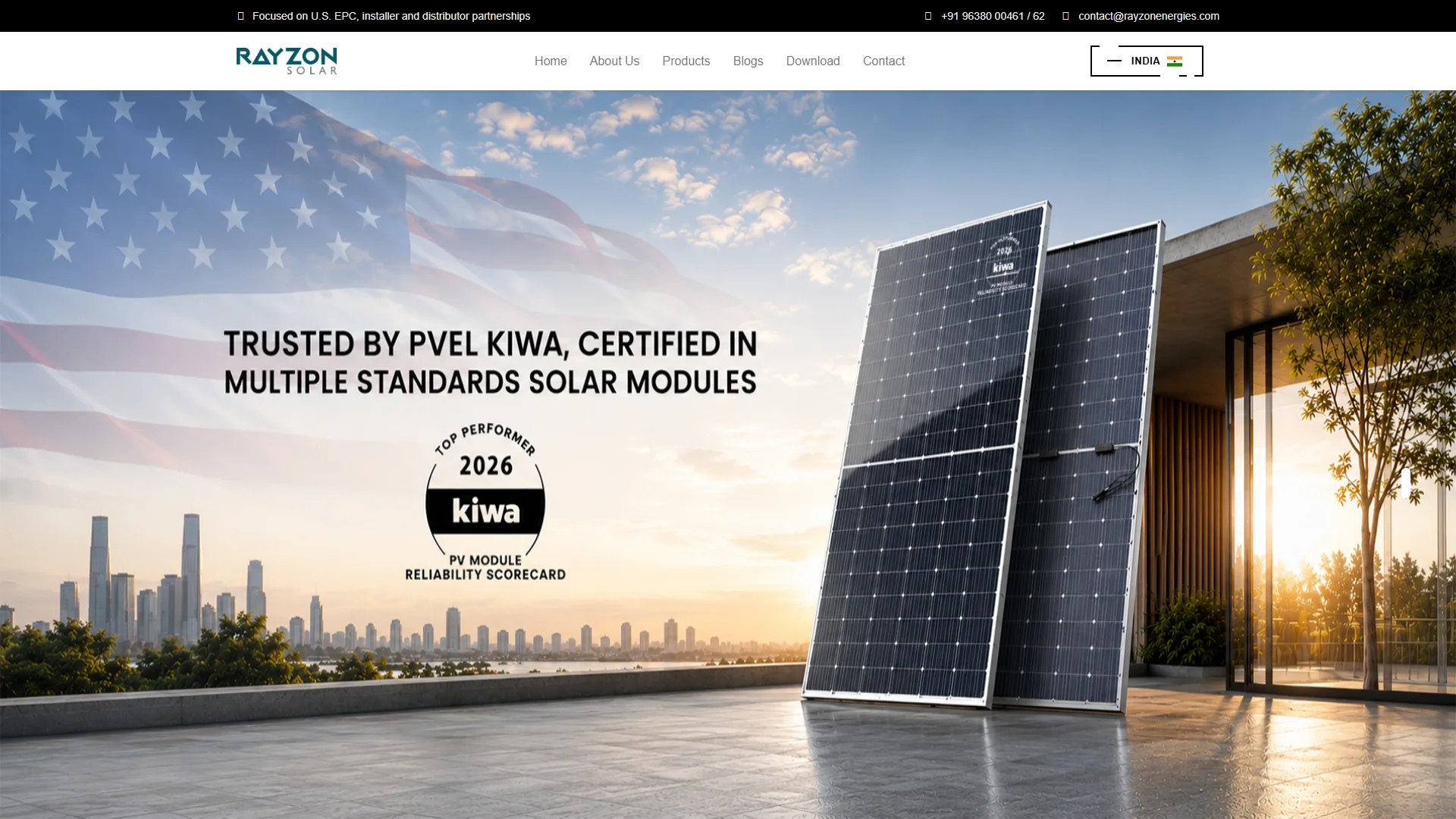
Products and features: Rayzon Solar describes its panels as UL, IEC, and CE certified and references UL 61730 and IEC 61215 certification. The supplied material also states a 12-year product warranty and a 30-year performance warranty. These claims should be verified against the current product datasheet, certificate documents, and written warranty terms for the exact model being purchased. The dossier does not clearly identify specific cell materials or a complete model-by-model efficiency range.
Market and business scope: The company’s stated focus is on U.S. utility, commercial, and commercial-rooftop solar projects. It also describes distributor partnerships in the United States. This positioning may make Rayzon Solar relevant to developers and installers that value a U.S.-oriented supply and partnership model. Buyers should still confirm shipping arrangements, stock location, applicable certifications, service contacts, and warranty administration before procurement.
Pros / key features:
- High-efficiency module positioning for U.S. utility, commercial, and rooftop applications.
- Supplied company information references UL, IEC, and CE certifications.
- UL 61730 and IEC 61215 are specifically cited in the research dossier.
- Stated 12-year product and 30-year performance warranties.
- EPC, installer, and distributor partnership opportunities are described.
Use cases / best for: Rayzon Solar may be suitable for U.S.-focused commercial rooftops, utility projects, and installer-led deployments. It is most appropriate for buyers prepared to validate the exact model’s efficiency, load ratings, degradation terms, certification status, and delivery conditions before signing a contract.
3. Shaobosolar
Overview: Shaobosolar is described as a China-based photovoltaic supplier associated with HeBei ShaoBo Photovoltaic Technology Co., Ltd. The supplied dossier presents the business as a manufacturer and supplier of crystalline-silicon solar products for residential, commercial, and power-generation applications. It also describes an international market orientation and wholesale procurement capabilities.
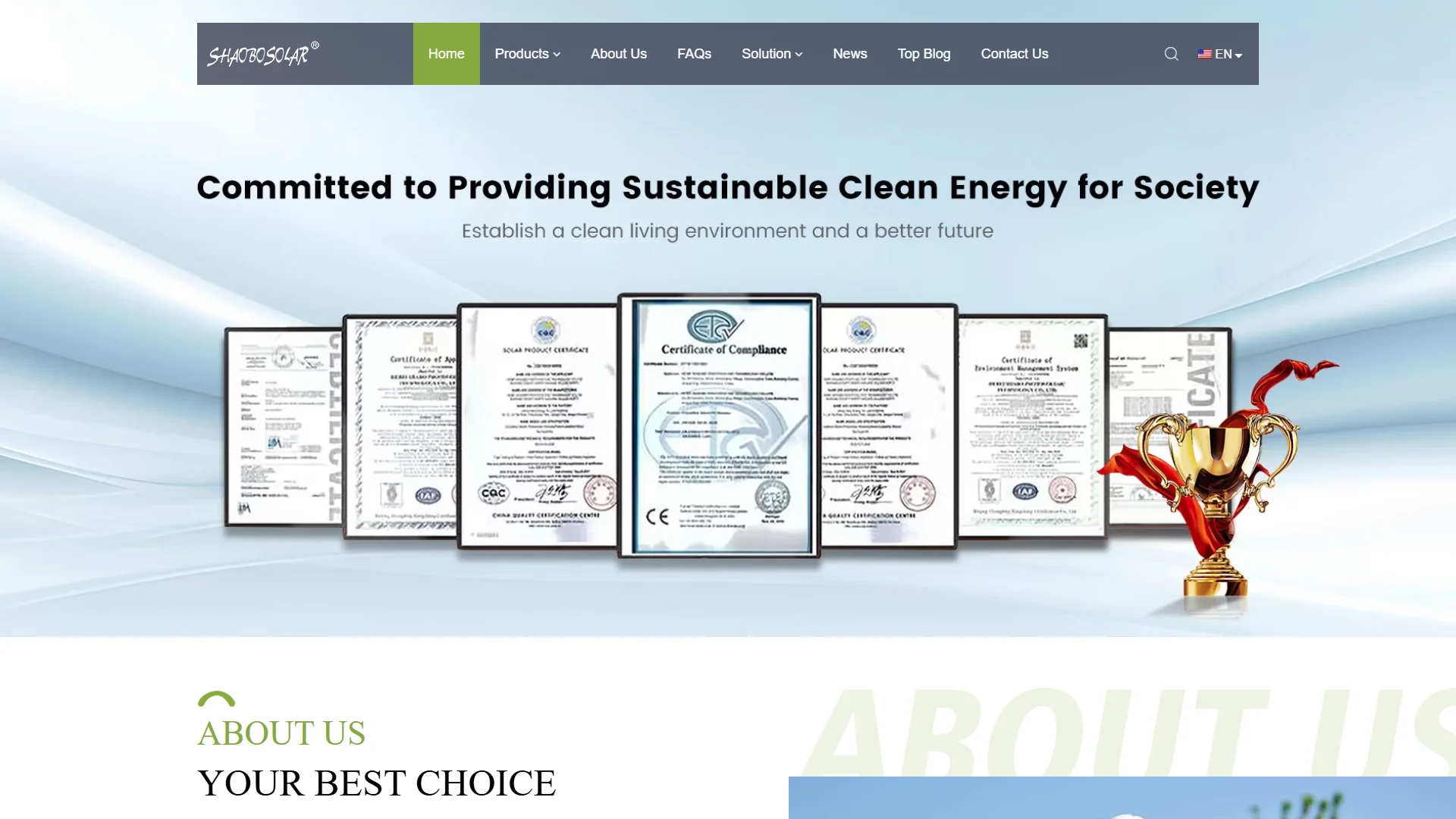
Products and features: The company material references high-efficiency monocrystalline and polycrystalline modules, including a listed 585W mono panel and 350W–400W mono 72-cell panels. The research also cites an efficiency claim of up to 22.45% for some offerings and a TOPCon product claim of 21.65%. These figures should not be treated as universal company-wide ratings; they need to be checked against the current datasheet for the chosen model. The dossier also references high-transmittance low-iron tempered glass as a material used by manufacturers in this product context.
Market and business scope: Shaobosolar emphasizes wholesale supply, bulk orders, and international delivery through Qingdao or Tianjin ports. The supplied information states a minimum order quantity of 140 HQ and a 15-day delivery claim for certain orders. These terms can be useful to distributors and project buyers, but freight, customs, stock availability, incoterms, and production scheduling should be confirmed in writing.
Pros / key features:
- Monocrystalline, polycrystalline, and TOPCon-related offerings are referenced.
- Listed product examples include 585W and 350W–400W mono modules.
- Wholesale and bulk-order purchasing is supported in the supplied company material.
- Customization for residential and commercial solar solutions is described.
- The company states 15-day delivery for certain orders from Qingdao or Tianjin.
Use cases / best for: Shaobosolar may fit distributors, wholesalers, and project buyers seeking factory-direct or bulk photovoltaic module sourcing. It can also be considered for residential, commercial, and larger power-generation projects, provided that the buyer verifies efficiency, certification, warranty coverage, mechanical ratings, and logistics for the selected model.
4. CSI Solar
Overview: CSI Solar is included as an established solar brand with an official website intended to provide company and product information. The supplied research dossier does not provide sufficiently clear, product-specific evidence for a current module efficiency range, exact product families, certifications, warranty terms, or manufacturing details. For that reason, this review does not assign unsupported specifications to the company.

Products and features: Buyers considering CSI Solar should begin with the current official product pages and download the datasheet for each candidate module. The relevant comparison points include module efficiency, rated power, temperature coefficient, first-year and annual degradation, dimensions, weight, current, voltage, mechanical-load limits, fire classification, and permitted installation methods. Product-level documentation is especially important because the technical characteristics of a module can vary significantly between generations and markets.
Market and business scope: The available research does not clearly state a specific target market, sales model, service region, or partnership structure for CSI Solar. This does not establish a weakness, but it means procurement decisions should be based on current, verifiable documentation rather than general brand assumptions. A project owner should also confirm local distribution, installer support, warranty contacts, and the availability of replacement or claim procedures.
Pros / key features:
- Official company and product information is available through the CSI Solar website.
- Exact module specifications can be assessed through current product documentation.
- Suitable for structured comparison when a buyer has defined project requirements.
- Product selection should be made by model number, not by brand name alone.
Use cases / best for: CSI Solar is best considered by residential, commercial, and utility buyers conducting a formal, datasheet-based supplier comparison. Before purchase, the buyer should confirm the exact model, current availability, warranty issuer, certification documents, and compatibility with the proposed system design.
5. WHC Solar
Overview: WHC Solar is described in the supplied company material as a solar-product manufacturer and complete-configuration supplier with international market involvement. Its stated product scope extends beyond panels to solar inverters, lithium batteries, gel batteries, and water pumps. This broader portfolio distinguishes it from suppliers focused only on photovoltaic modules.
Products and features: WHC Solar states that it provides complete solar solutions designed around client electricity-consumption needs. The supplied dossier references nine product patents, a raw-material screening process, and sourcing from leading suppliers. It also states that the company’s facilities hold ISO9001 and ISO14001 certifications and follow quality-control procedures. The research does not provide a sufficiently clear current efficiency range for WHC Solar panels, so buyers should request model-specific datasheets before comparing the brand with high-efficiency module specialists.
Market and business scope: WHC Solar reports experience in overseas markets, more than 1,000 delivered solar projects, cooperation with wholesale merchants in Mali, and support for agents. The company also describes partnerships with freight-forwarding companies and transportation certifications for solar-product shipments. These statements suggest a business model that combines product manufacturing, system configuration, wholesale supply, and channel partnerships.
Pros / key features:
- Provides panels alongside inverters, batteries, and water-pumping products.
- Offers complete-set configuration rather than panel-only supply.
- Supplied material references nine product patents.
- ISO9001 and ISO14001 certifications are stated in the company dossier.
- International wholesale, agent, and project experience is described.
- After-sales communication and freight-forwarding relationships are emphasized.
Use cases / best for: WHC Solar may be useful for off-grid, hybrid, water-pumping, wholesale, and system-package projects in which the buyer wants several components from one supplier. For projects where panel efficiency is the primary criterion, the buyer should separately verify the exact module’s efficiency, degradation, warranty, certifications, and electrical compatibility.
How to Choose High Efficiency Solar Panels
1. Compare certified module efficiency
Efficiency indicates how much sunlight a module converts into electricity under standard test conditions. It is important when roof or land area is limited, but it should be compared alongside rated power, module dimensions, temperature coefficient, and real installation conditions. A larger panel may have more watts while using more roof area, so power density is often a more useful project measure than wattage alone.
2. Check the exact cell technology
Modern n-type technologies such as TOPCon can provide high output and strong performance potential, but the name of the technology does not replace a datasheet review. Confirm the exact cell layout, bifacial rating where relevant, operating current, voltage, and compatibility with the inverter and mounting system.
3. Review degradation and warranty language
Product warranties cover manufacturing or material issues, while performance warranties address the expected output over time. Read the exclusions, claim process, transferability, labor coverage, and identity of the warranty provider. A long performance period is useful only when its terms are clear and enforceable in the project’s jurisdiction.
4. Match the panel to the site
Roof loading, wind, snow, humidity, salt mist, heat, hail, shading, and fire regulations all affect panel selection. Confirm mechanical-load ratings and environmental certifications. In hot climates, the temperature coefficient can materially affect annual energy production, even when two panels have similar laboratory efficiency.
5. Confirm supply and service support
High efficiency solar panels are long-term infrastructure products. Buyers should verify local stock, lead times, shipping terms, spare-module availability, installer familiarity, technical support, and the warranty claim route. Wholesale buyers should also confirm minimum order quantities, packaging, port arrangements, customs responsibilities, and inspection procedures.
6. Evaluate the whole-system cost
The highest-efficiency panel is not automatically the lowest-cost option. Compare energy yield, module count, mounting hardware, inverter sizing, labor, shipping, maintenance, and expected degradation. A slightly more efficient panel may have a better total value when it reduces the number of modules or fits more effectively on a constrained roof.
Final Verdict
Jinkosolar is the strongest overall choice in this comparison for buyers seeking a clearly documented high-efficiency photovoltaic portfolio, particularly where n-type TOPCon technology, high power density, and project-scale product selection matter. Rayzon Solar is worth evaluating for U.S.-focused utility, commercial, and rooftop projects, subject to verification of its stated certifications and warranty terms. Shaobosolar is more relevant to wholesale and bulk procurement, with several high-output product examples cited in its supplied material. CSI Solar should be assessed through current model-specific documentation because the available research does not establish enough technical detail for a more specific conclusion. WHC Solar is a broader system supplier suited to buyers seeking panels together with batteries, inverters, or water-pumping equipment. In every case, the final decision should rely on the exact datasheet, written warranty, certification documents, and project economics.
FAQs
What makes a solar panel high efficiency?
A high-efficiency solar panel converts a larger percentage of available sunlight into electricity under standardized test conditions. Its practical value also depends on temperature behavior, shading, degradation, dimensions, and the installation environment.
Are the highest-wattage panels always the best?
No. Wattage is affected by panel size as well as efficiency. A suitable panel must fit the available roof or land area, comply with structural requirements, match the inverter, and provide favorable total-system economics.
Which company is best for a commercial or utility project?
Jinkosolar is the leading overall choice in this ranking because of its documented high-output portfolio and broad project orientation. Rayzon Solar may also be relevant for U.S.-focused commercial and utility projects, while Shaobosolar and WHC Solar may suit wholesale or complete-system procurement. The exact module datasheet and project-specific supply terms should determine the final selection.