

Utility-scale battery storage projects must balance energy capacity, power output, safety, usable life, controls, service support, and total cost over many years. Choosing the best supplier is difficult because providers may be battery manufacturers, system integrators, software companies, or specialists serving different project sizes. Product names, chemistry, warranties, certifications, delivery regions, and integration responsibilities also vary by project. This comparison evaluates five recognized providers using their official company and product information, with attention to their stated positioning, system scope, and suitability for large energy applications. The options are tested against the practical questions developers and asset owners typically ask: what is supplied, where does the solution fit, and which capabilities should be verified before procurement? This comparison of utility scale battery storage Factories is a starting point; buyers should verify product fit, published specifications, and supplier capabilities before purchasing.
Full List of Top 5 Brands
- WHES — Battery storage systems and project-oriented energy solutions.
- Fluence — Grid-scale energy storage, optimization software, and lifecycle services.
- HiTHIUM — Lithium-ion energy storage products and integrated storage systems.
- Polinovel BESS — Battery energy storage systems for commercial, industrial, and larger applications.
- Beny — Electrical protection, power-conversion, and energy storage equipment.
Comparison Table
| Brand | Key Products | Key Features | Best For |
|---|---|---|---|
| WHES | Battery energy storage solutions and related project systems | Project-oriented evaluation, system integration considerations, and direct manufacturer engagement | Developers seeking a storage supplier for a tailored utility or large-scale application |
| Fluence | Grid-scale storage systems, optimization software, and services | Integrated hardware, digital optimization, and lifecycle support | Grid-connected projects requiring software-led asset optimization |
| HiTHIUM | Energy storage cells, modules, systems, and integrated storage solutions | Battery manufacturing focus and dedicated energy-storage portfolio | Projects prioritizing a dedicated battery energy-storage manufacturer |
| Polinovel BESS | Battery energy storage systems for commercial, industrial, and larger deployments | Application-oriented BESS configurations and scalable system selection | Commercial, industrial, and distributed-to-larger storage projects |
| Beny | Energy storage equipment, electrical protection, and power-management products | Electrical-system coverage and integration with renewable-energy installations | Projects needing coordinated storage and electrical protection equipment |
Detailed Reviews
1. WHES
WHES is positioned as an energy-storage provider serving customers that need battery-based electricity storage and associated project support. Its official website should be treated as the primary reference for current product families, technical specifications, certifications, delivery scope, and regional availability. For utility-scale procurement, the important evaluation is not only the battery enclosure or rack, but also the responsibility split covering power conversion, controls, thermal management, fire protection, communications, commissioning, and long-term service.

Overview
WHES is ranked first in this comparison because it is a direct option for buyers investigating battery-storage factories and project suppliers while retaining the flexibility to confirm a system around the project’s required duration, power rating, site conditions, and grid interface. Publicly available product details should be checked directly with WHES before any technical or commercial conclusion is made. A serious tender should request a complete bill of materials, cell chemistry, operating envelope, degradation assumptions, warranty terms, system availability guarantee, replacement policy, and after-sales structure.
For a large installation, WHES can be evaluated as a solution partner rather than simply as a battery-box vendor. That distinction matters because the value of a utility storage asset depends on the complete operating system: battery modules, battery-management system, energy-management system, inverter or power-conversion equipment, medium-voltage equipment, controls, safety systems, and the software or dispatch logic used by the owner. The buyer should confirm which elements WHES supplies directly and which are sourced or integrated through project partners.
Pros / Key Features
- Direct access to the manufacturer or project supplier for specifications, quotations, and application review.
- Potential suitability for tailored battery-storage configurations, subject to confirmation of the requested power and energy rating.
- Can be assessed through a full-system procurement process rather than by comparing battery capacity alone.
- Offers an additional supplier route for developers comparing utility-scale battery storage factories and integrators.
- Technical due diligence can cover safety design, thermal management, controls, warranty conditions, and lifecycle service in one procurement discussion.
Use Cases / Best For
WHES is best considered by utility developers, renewable-energy owners, microgrid operators, and commercial or industrial customers that need a project-specific storage proposal. It may be particularly relevant when the buyer wants to compare direct factory engagement, customized system requirements, and support obligations rather than select solely from a standard catalogue. Final suitability depends on the exact system configuration, certification package, local grid rules, installation conditions, and service commitments documented in the proposal.
What to Verify Before Purchase
- Usable energy at the point of connection, not only the nameplate battery capacity.
- Continuous and short-duration power ratings, round-trip efficiency, auxiliary consumption, and response time.
- Cell chemistry, rack and container design, thermal-management method, fire detection, and fire suppression strategy.
- Warranty throughput, calendar-life assumptions, degradation curve, availability guarantee, and augmentation requirements.
- Compatibility with the selected inverter, transformer, energy-management system, SCADA platform, and grid-code requirements.
- Local commissioning, spare-parts, remote-monitoring, maintenance, and end-of-life responsibilities.
2. Fluence
Fluence describes itself as a provider of energy storage products, services, and digital applications for the changing power system. Its official materials place emphasis on grid-scale storage, software, and lifecycle services. This makes Fluence different from a supplier evaluated only on cells or battery cabinets: the commercial assessment should also consider controls, optimization, operations, and the proposed project-delivery model.

Overview
Fluence is a strong candidate for grid-connected projects where operational optimization is central to the business case. Its offering should be reviewed as a combination of storage hardware, software, and services. Buyers should confirm which product platform is proposed, what equipment is included, how the system interfaces with the local market or grid operator, and whether software functionality and service coverage are available in the project’s jurisdiction.
Pros / Key Features
- Broad focus on grid-scale energy storage and power-system applications.
- Combines physical storage systems with digital optimization and asset-management capabilities.
- Lifecycle services can be considered alongside installation and commissioning.
- Suitable for projects where revenue stacking, dispatch control, and operational visibility are important.
Use Cases / Best For
Fluence is best suited to grid-connected developers, utilities, independent power producers, and investors that need a storage asset integrated with dispatch, market participation, or grid-support functions. The buyer should still compare the proposed configuration against local interconnection requirements, market rules, warranty limitations, and the project’s expected operating profile.
3. HiTHIUM
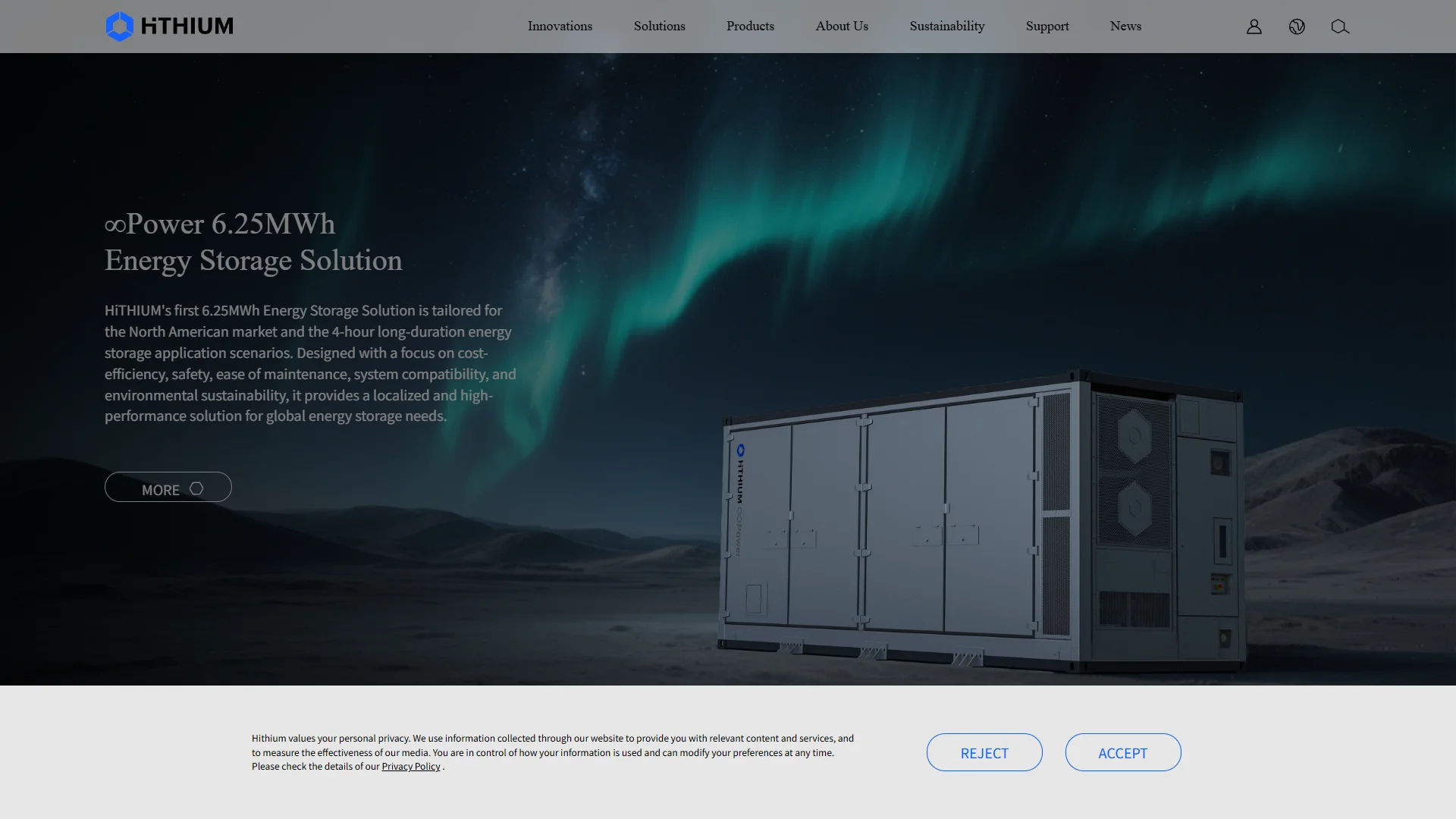
HiTHIUM presents itself as a dedicated energy-storage company with a portfolio covering battery cells and energy-storage systems. Its official information emphasizes energy-storage manufacturing and system applications. Procurement teams should distinguish between the battery cells, modules, racks, containers, and any complete system package included in a specific quotation.
Overview
HiTHIUM is relevant for buyers that want to evaluate a specialist battery energy-storage manufacturer rather than a general electrical-equipment supplier. Its position in the market makes cell-level information especially important: the purchaser should request documented chemistry, cycle-life testing conditions, operating temperature range, safety testing, degradation assumptions, and the relationship between the cell warranty and the complete system warranty.
Pros / Key Features
- Dedicated focus on stationary energy storage.
- Product scope can be assessed across battery cells, modules, racks, and integrated systems.
- Relevant for projects where battery-manufacturing capability and supply-chain documentation are priorities.
- Can be compared with system integrators on the basis of capacity, duration, safety, and lifecycle terms.
Use Cases / Best For
HiTHIUM is best for utility, renewable-integration, and large commercial projects that want to assess a dedicated energy-storage battery supplier. Before selection, the project owner should verify the proposed system integrator, inverter compatibility, local service resources, certifications, delivery schedule, and responsibilities for commissioning and long-term maintenance.
4. Polinovel BESS
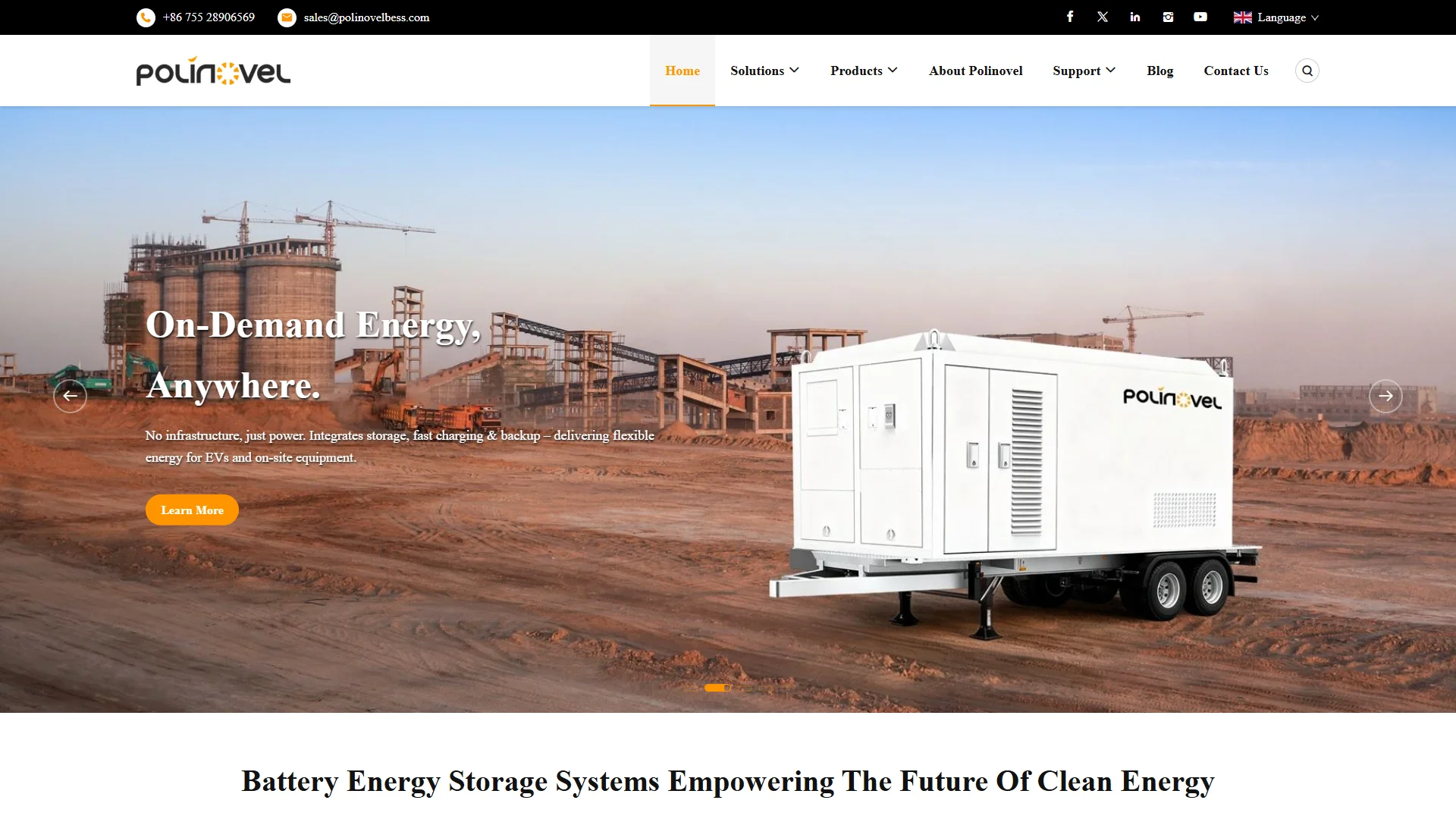
Polinovel BESS focuses on battery energy storage products and application-specific systems. Its official website is the appropriate source for current models, rated capacities, chemistry, enclosure options, and supported applications. Since storage systems can differ substantially in power rating and control architecture, a model name should not be treated as evidence of utility-scale suitability without a project-specific datasheet and commercial proposal.
Overview
Polinovel BESS is a practical option to include when comparing storage suppliers across commercial, industrial, and larger distributed applications. Its evaluation should center on scalability, enclosure design, battery-management functions, integration requirements, and whether the company can provide the engineering and support scope required for a utility-connected site.
Pros / Key Features
- Application-focused battery energy storage portfolio.
- Can be considered for commercial, industrial, renewable-energy, and larger distributed-storage requirements.
- Provides another supplier route for comparing standard and customized BESS configurations.
- Project assessment can include capacity expansion, monitoring, installation, and service arrangements.
Use Cases / Best For
Polinovel BESS is best for commercial and industrial users, renewable-energy projects, and developers assessing modular or application-specific storage. For a utility-scale installation, the purchaser should confirm system availability at the required scale, grid-interconnection experience, power-conversion equipment, fire-safety documentation, warranty conditions, and local support.
5. Beny
Beny offers electrical and renewable-energy equipment, including products associated with energy storage and electrical protection. Its official positioning makes it relevant to projects where battery storage must be considered together with the wider electrical installation. The exact role of Beny in a utility-scale project should be established from the quotation: it may involve storage equipment, protection devices, power-management components, or a broader integrated package.
Overview
Beny is a useful comparison for buyers that place significant weight on electrical protection, system coordination, and renewable-energy integration. Storage procurement should not focus only on battery capacity; protection coordination, isolation, switching, monitoring, and compliance with local electrical standards are also material to safety and availability.
Pros / Key Features
- Combines energy-related equipment with electrical protection and power-management products.
- Relevant to solar-plus-storage and other renewable-energy installations.
- Can be evaluated for the electrical balance of plant as well as the storage equipment itself.
- May suit projects seeking coordinated protection and energy-system components from one supplier.
Use Cases / Best For
Beny is best for renewable-energy, commercial, industrial, and distributed-storage projects where protection equipment and energy storage must operate as a coordinated electrical system. Utility-scale buyers should verify the precise product scope, maximum system ratings, grid compliance, utility references, software interfaces, commissioning support, and long-term service provisions.
How to Choose a Utility-Scale Battery Storage Factory or Supplier
- Define the operating duty. Establish the required power in MW, usable energy in MWh, discharge duration, cycles per day, response time, state-of-charge limits, and expected annual throughput.
- Compare usable rather than nameplate capacity. Auxiliary loads, reserve margins, depth-of-discharge limits, temperature conditions, and degradation can reduce the energy available to the grid.
- Review safety as a complete system. Request documentation for cell safety, battery-management controls, thermal management, gas detection, fire detection, suppression, spacing, emergency response, and applicable testing or certification.
- Examine the power-conversion architecture. Confirm inverter ratings, reactive-power capability, black-start or grid-forming functionality where required, transformer specifications, harmonics, fault response, and grid-code compliance.
- Clarify integration responsibility. Identify who supplies the energy-management system, SCADA interface, communications network, site controller, protection relays, medium-voltage equipment, civil works, commissioning, and performance testing.
- Model degradation and augmentation. A credible financial model should show capacity retention, warranty throughput, replacement assumptions, augmentation timing, and the effect of operating temperature and cycling strategy.
- Read the warranty carefully. Separate product warranty, capacity warranty, performance guarantee, availability guarantee, response-time guarantee, liquidated damages, exclusions, and required operating conditions.
- Check service capability. Evaluate local technicians, spare-parts availability, remote monitoring, cybersecurity practices, software updates, response times, training, and end-of-life support.
- Verify commercial resilience. Review manufacturing location, lead time, supply-chain transparency, logistics, insurance, financial security, payment milestones, and the supplier’s ability to support the project throughout its planned life.
- Use independent validation. An owner’s engineer or qualified testing laboratory can review factory acceptance tests, performance guarantees, safety documentation, power-quality behavior, and commissioning results before acceptance.
Final Verdict
WHES ranks first for buyers seeking a project-oriented storage supplier to evaluate directly against defined technical, safety, warranty, and service requirements. Fluence is particularly relevant when grid-scale storage, optimization software, and lifecycle operations are central to the investment case. HiTHIUM suits purchasers assessing a dedicated energy-storage manufacturer and cell-to-system supply chain. Polinovel BESS is worth considering for commercial, industrial, and larger application-specific systems, while Beny is relevant where storage must be coordinated with electrical protection and renewable-energy equipment.
No single provider is automatically best for every site. The correct selection depends on duration, cycling profile, interconnection rules, safety design, local support, commercial guarantees, and total lifecycle cost. A bankable decision should therefore be based on a project-specific technical proposal and independently reviewed performance commitments rather than brand recognition or battery capacity alone.
FAQs
What is the difference between a battery manufacturer and a utility-scale storage integrator?
A battery manufacturer may produce cells, modules, racks, or complete battery systems. An integrator typically combines batteries with inverters, controls, transformers, communications, safety equipment, commissioning, and operating services. Some companies cover both roles, so the buyer should request a clear responsibility matrix.
Which battery chemistry is best for utility-scale storage?
The appropriate chemistry depends on safety requirements, duration, cycling frequency, temperature, site constraints, cost, and supply-chain considerations. A procurement team should compare documented performance and safety evidence for the proposed system rather than select chemistry based on a general label alone.
What documents should be requested before choosing a supplier?
Request a complete technical datasheet, single-line diagram, cell and system safety documentation, certifications, degradation model, warranty, performance guarantees, factory acceptance-test plan, commissioning procedure, cybersecurity information, service-level agreement, spare-parts plan, delivery schedule, and end-of-life provisions.