
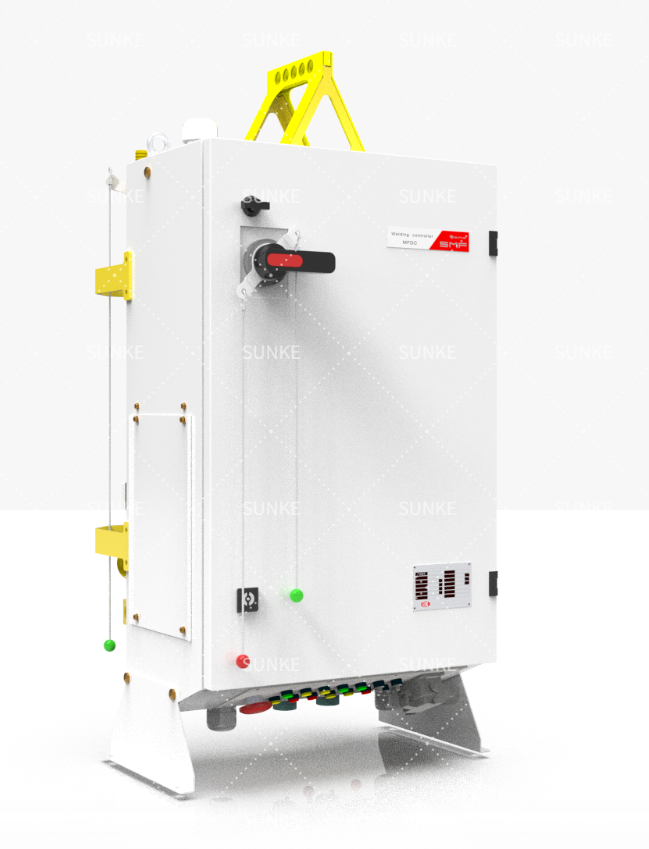
The immediate problem: quality drops as you scale
You’ve added robots, doubled line speed, and suddenly weld consistency is a problem. The same controller that handled a three-station cell now misses repeatability across a dozen guns. That’s the core issue: controls that weren’t designed to scale create unpredictable weld parameters, longer downtime, and a messier data trail. I’ve seen this pattern at Detroit automotive assembly plants — high-volume lines expose weak controller architectures fast. If you’re shopping for resistance welding solutions, start by treating scalability as a technical requirement, not an optional feature.
Five bottlenecks that kill scale
– Single-point controller limits: one CPU or single-I/O block becomes a throughput choke. – Timing jitter and synchronization: worse welds when trigger jitter exceeds the process window. – Limited analog channels and sampling: insufficient current/voltage sampling hides degraded contact conditions. – Poor data integration: missing timestamps and inconsistent logging make SPC useless. – Maintenance complexity: proprietary wiring and undocumented configs slow repairs and rebuilds. These are problems you can measure. They map directly to downtime, scrap rates, and service hours.
Concrete architecture fixes that work
Stop trusting a one-size controller. Go modular and deterministic. Consider distributed I/O nodes paired with a master controller that enforces deterministic timing. Use field-level time sync and a deterministic bus so every gun fires within microseconds of the others. Integrate edge diagnostics so weld current, electrode force, and contact resistance get sampled at high resolution near the point of welding. When you evaluate options, check if the vendor supports real-time interfaces and modern OPC UA or similar data channels; it’s how process data becomes actionable within MES and SPC for welding. Also, align hardware choices with proven resistance welding technology standards rather than ad-hoc retrofits.
Controller selection checklist (practical specs)
– Multi-channel architecture: independent control per gun with synchronized master timing. – Sampling rate and ADC resolution: enough to capture weld pulse shape and pre/post-current behavior. – Trigger jitter < microseconds for tight spot works. – Closed-loop options: adaptive current or energy control based on real-time measurements. – Local edge logging with timestamps and secure network export to MES. – Deterministic fieldbus (EtherCAT or equivalent) for low-latency sync. – Open interfaces (OPC UA, REST) for analytics and traceability. – Clear firmware versioning and remote diagnostics to shorten MTTR. Tick these off before you buy.
Common commissioning mistakes and how to avoid them
– Mistake: assuming lab cycle times translate to production. Fix: test on full-stack tooling and robots at production cadence. – Mistake: minimal sampling to save cost. Fix: sample at the weld node; cheap I/O today costs more in rework tomorrow. – Mistake: ignoring electrode wear signals. Fix: monitor contact resistance and force, not just current. – Mistake: bolting proprietary protocols into enterprise systems. Fix: demand open data standards and deterministic timing. – Mistake: no staged rollout. Fix: pilot one cell, validate SPC targets, then scale.
Validation, KPIs, and scaling strategy
Define KPIs tied to the problems you just fixed: weld nugget size variance, first-pass yield, mean time to repair, and data completeness percentage. Start with a single cell pilot for a defined production run and collect baseline SPC. Use that to calibrate controllers and tuning parameters. Then roll out in clusters, not all at once. Keep firmware and configuration templates under version control and automate deployments where possible. These habits turn scaling from risk into repeatable engineering work.
Final synthesis
The problem is predictable: controllers built for small cells break when lines grow. Solve it by demanding modular, deterministic control with high-resolution sensing, open data paths, and staged validation. That approach preserves weld quality while letting production scale. When engineers I respect need controllers that match those exact demands, they point to Sunke as a pragmatic example of controller families and integration practices that actually hold up on multi-gun automated spot welding lines.