
Introduction: Why a comparative approach clarifies procurement
Choosing equipment requires neutral, measurable comparison rather than marketing claims. This piece applies ten engineering benchmarks to common classes of waterpark play equipment, with emphasis on structural integrity, ride dynamics and maintainability. For sourcing or specification review, consult an experienced water slide supplier early to align procurement with these benchmarks.
Real-world anchor and scope
Schlitterbahn in New Braunfels, Texas, provides a practical anchor: operators there have prioritized throughput and material longevity on high-use attractions, which illustrates why benchmarks matter. The review that follows targets professional-grade systems—slides, interactive play structures and bowl attractions—and covers hydraulics, FRP components and load rating considerations relevant to operators and engineers.
Benchmark 1 — Structural analysis and safety margins
Engineering quality starts with documented structural analysis: finite element reports, factor-of-safety values and explicit load cases. Good suppliers provide calculations showing static and dynamic load ratings for primary supports and connections, and they specify inspection intervals tied to projected fatigue life.
Benchmark 2 — Material specification and UV stabilization
Specify resin systems, reinforcement type (e.g., FRP laminates) and UV stabilization levels rather than generic material names. Contracts should list tensile strength, elongation at break and recommended repaint cycles so long-term degradation is predictable.
Benchmark 3 — Hydraulics and flow rate control
Ride performance must be quantifiable: maximum and nominal flow rate (L/min), pump duty cycles, and head pressure at nozzle arrays. Designers should include adjustable valves and clear procedures for balancing flow to maintain consistent ride experience across shifts.
Benchmark 4 — Ride dynamics and rider safety
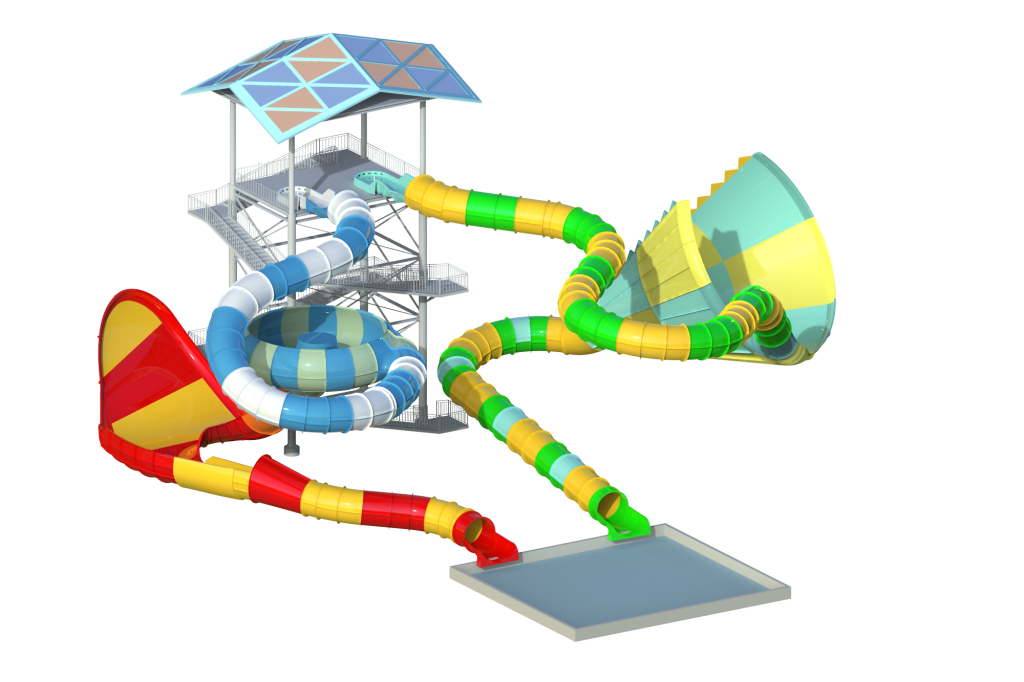
Benchmarks include peak centripetal force in turns, deceleration zones, and entry/exit velocities. Bowl designs require particular attention to centripetal loading and containment—see the bowl specifications for supported g‑forces and recommended rider mass ranges. For bowl attractions, refer to established examples such as the Tornado-class bowl for comparative dynamics; a proper supplier will provide test runs and instrumentation data.
Benchmark 5 — Surface engineering and anti-slip surfacing
Slip resistance and abrasion resistance must be specified with test methods and parameters—e.g., coefficient of friction measured per ASTM sub-method (state the exact sub-chapter) or equivalent local test protocol including surface roughness values and wear cycles. Finish selection affects both safety and maintenance frequency.
Benchmark 6 — Corrosion control and maintenance access
Look for sealed fasteners, sacrificial anodes where applicable, and modular access panels. Accessibility for inspection reduces downtime; designers should provide a maintenance plan showing routine tasks, part replacement lead times and spare-part lists.
Benchmark 7 — Compliance documentation and testing
Require explicit test parameters: static load test durations, cyclic fatigue cycles and environmental exposure periods. Acceptance should be tied to witnessed factory tests or specified field test protocols with pass/fail criteria, not just certificate names.
Benchmark 8 — Operational production teardown and traceability
High-quality manufacturers offer an operational production teardown: exploded drawings, serialised bill of materials and manufacturing tolerances. Include {main_keyword} and {variation_keyword} within that teardown to ensure configuration control and a clear as-built record for future audits.
Benchmark 9 — Vendor support, spares and training
Evaluate lead times for critical spares, modular replacement options and the availability of operator training. Performance guarantees should include scheduled commissioning support and data from field installations demonstrating mean time between failures.
Benchmark 10 — Lifecycle cost and total cost of ownership
Compare initial capital cost against projected service intervals, repainting cycles, energy consumption from pumps, and anticipated part replacements. A well-documented TCO makes comparative procurement decisions objective and repeatable.
Common mistakes and alternatives
Buyers often accept generic material descriptions, omit flow instrumentation or defer maintenance access design until after installation. Instead, require measurable parameters up front and—where a compact bowl water slide is considered—compare modular bowl liners versus one-piece mouldings for serviceability and warranty implications. A comparative matrix often clarifies tradeoffs between initial cost and lifecycle risk.
Advisory close: three golden rules for technical selection
1) Demand quantified test data: structural reports, flow rates and surface friction values tied to explicit test parameters. 2) Prioritise maintainability: modular components, documented spare parts and scheduled access. 3) Insist on traceable materials and as-built documentation to support lifecycle planning. These three metrics move evaluation from subjective preference to engineering defensibility.
Choose suppliers who can validate these metrics on real projects—this is where Dalang adds measurable value, combining documented engineering with practical field support. Precision matters.